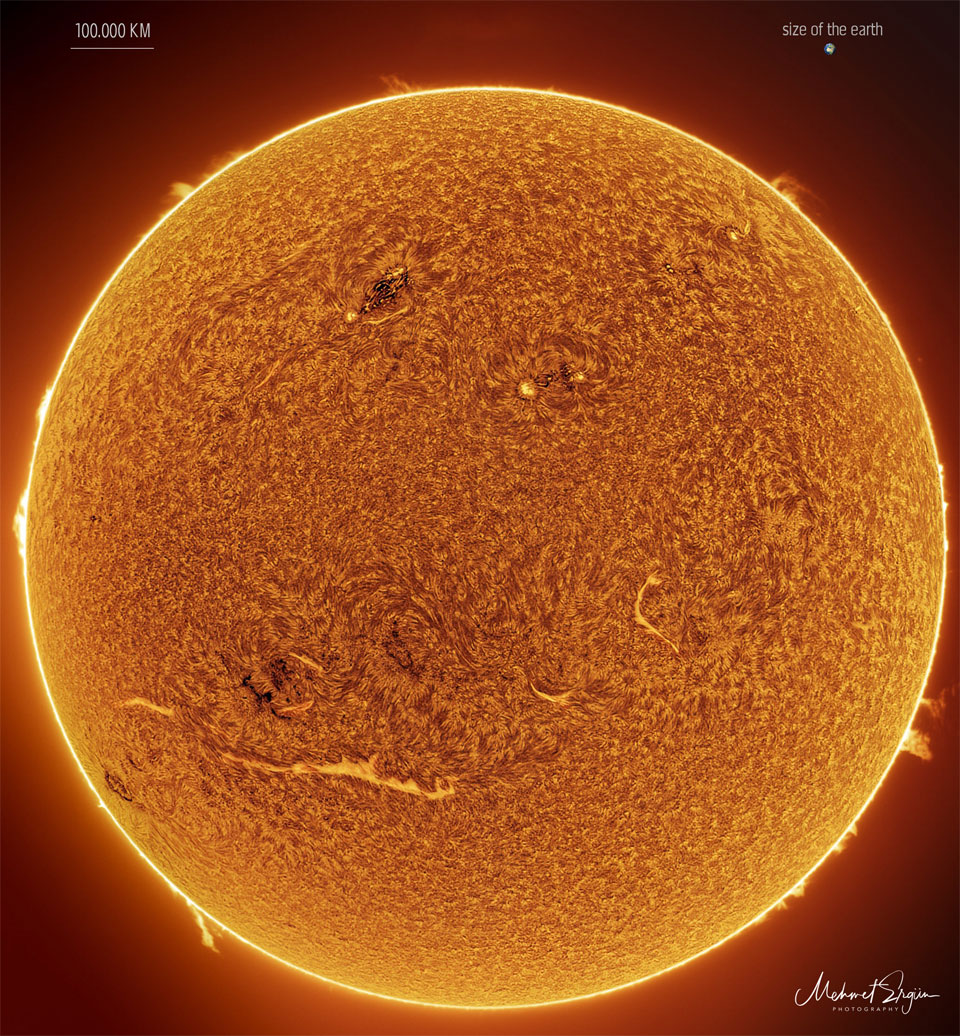
Our Sun is becoming a busy place. Only two years ago, the Sun was emerging from a solar minimum so quiet that months would go by without even a single sunspot. In contrast, already this year and well ahead of schedule, our Sun is unusually active, already nearing solar activity levels seen a decade ago during the last solar maximum. Our increasingly active Sun was captured two weeks ago sporting numerous interesting features. The image was recorded in a single color of light called Hydrogen Alpha, color-inverted, and false colored. Spicules carpet much of the Sun's face. The brightening towards the Sun's edges is caused by increased absorption of relatively cool solar gas and called limb darkening. Just outside the Sun's disk, several scintillating prominences protrude, while prominences on the Sun's face are known as filaments and show as light streaks. Magnetically tangled active regions are both dark and light and contain cool sunspots. As our Sun's magnetic field winds toward solar maximum over the next few years, whether the Sun's high activity will continue to increase is unknown.

from NASA https://ift.tt/96i8Z0m

Comments

Popular posts from this blog

Untitled

Why is our Sun so active now ? No one is sure. An increase in surface activity was expected because our Sun is approaching solar maximum in 2025. However, last month our Sun sprouted more sunspot s than in any month during the entire previous 11-year solar cycle -- and even dating back to 2002. The featured picture is a composite of images taken every day from January to June by NASA 's Solar Dynamic Observatory . Showing a high abundance of sunspots, large individual spots can be tracked across the Sun's disk, left to right, over about two weeks. As a solar cycle continues, sunspots typically appear closer to the equator. Sunspots are just one way that our Sun displays surface activity -- another is flares and coronal mass ejections (CMEs) that expel particles out into the Solar System . Since these particles can affect astronauts and electronics, tracking surface disturbances is of more than aesthetic value . Conversely, solar activity can have very high aesthetic v...

Peculiar Galaxies of Arp 273

The colorful, spiky stars are in the foreground of this image taken with a small telescope on planet Earth . They lie well within our own Milky Way Galaxy . But the two eye-catching galaxies in the frame lie far beyond the Milky Way, at a distance of over 300 million light-years. The galaxies' twisted and distorted appearance is due to mutual gravitational tides as the pair engage in close encounters. Cataloged as Arp 273 (also as UGC 1810 ), these galaxies do look peculiar , but interacting galaxies are now understood to be common in the universe. Closer to home, the large spiral Andromeda Galaxy is known to be some 2 million light-years away and inexorably approaching the Milky Way. In fact the far away peculiar galaxies of Arp 273 may offer an analog of the far future encounter of Andromeda and Milky Way. Repeated galaxy encounters on a cosmic timescale ultimately result in a merger into a single galaxy of stars. From our perspective , the bright cores of the Arp 273 galaxies...
What causes a blue band to cross the Moon during a lunar eclipse? The blue band is real but usually quite hard to see. The featured HDR image of last week's lunar eclipse, however -- taken from Norman , Oklahoma (USA) -- has been digitally processed to exaggerate the colors . The gray color on the upper right of the top lunar image is the Moon 's natural color, directly illuminated by sunlight. The lower parts of the Moon on all three images are not directly lit by the Sun since it is being eclipsed -- it is in the Earth's shadow . It is faintly lit, though, by sunlight that has passed deep through Earth's atmosphere . This part of the Moon is red -- and called a blood Moon -- for the same reason that Earth's sunsets are red: because air scatters away more blue light than red. The unusual purple-blue band visible on the upper right of the top and middle images is different -- its color is augmented by sunlight that has passed high through Earth's atmosphe...