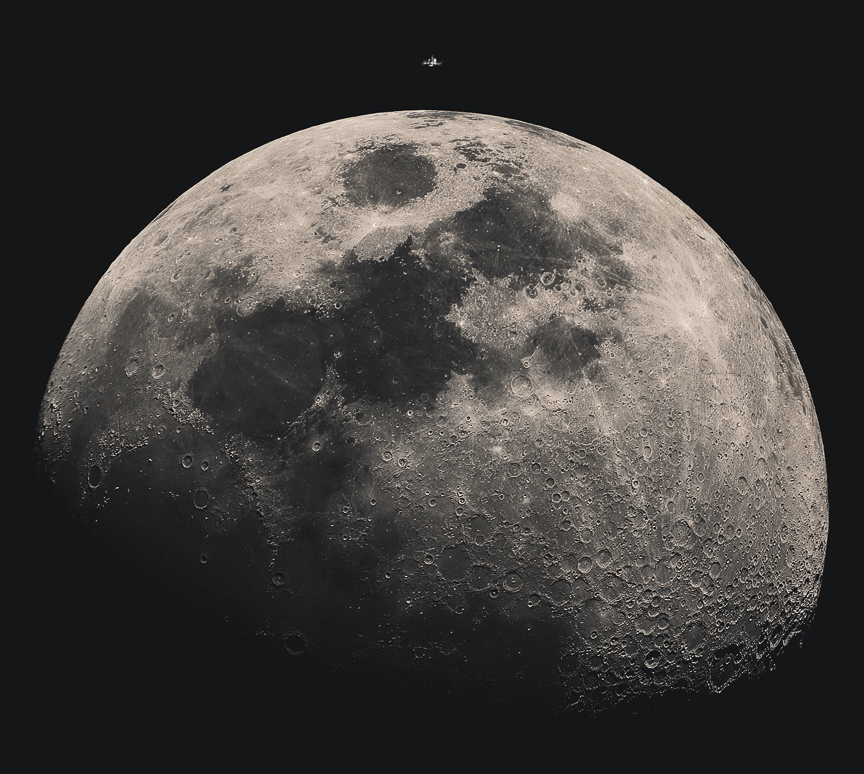
Nope, that is not an alien spaceship landing on the Moon! This is an image of the International Space Station (ISS) as it begins to transit in front of the Moon. The ISS is in low-Earth orbit (LEO) where it wizzes around the Earth every 90 minutes. Orbiting the Earth 16 times per day for 25 years, the ISS has photobombed many familiar celestial objects including Venus, Mars, Saturn, and the Sun. Thousands of experiments led by researchers from over one hundred countries have been conducted on the ISS. Growing protein crystals in low-gravity was one of the first experiments onboard the ISS and continues to contribute to new medical treatments. ISS astronauts study plant growth, water recycling, human health, and more to support the Artemis missions which will take humans farther than they’ve ever gone before. Next time you are out and about at night, try to spot the ISS zooming across the sky!

from NASA https://ift.tt/52i43bX

Comments

Popular posts from this blog

A Spiral Aurora over Iceland

What's happened to the sky? Aurora ! Captured in 2015, this aurora was noted by Iceland ers for its great brightness and quick development. The aurora resulted from a solar storm, with high energy particles bursting out from the Sun and through a crack in Earth's protective magnetosphere a few days later. Although a spiral pattern can be discerned, creative human s might imagine the complex glow as an atmospheric apparition of any number of common icons . In the foreground of the featured image is the Ölfusá River while the lights illuminate a bridge in Selfoss City . Just beyond the low clouds is a nearly full Moon. The liveliness of the Sun -- and likely the resulting auroras on Earth -- is slowly increasing as the Sun emerges from a Solar minimum , a historically quiet period in its 11-year cycle. from NASA https://ift.tt/2XgnyIE

NGC 2419: Intergalactic Wanderer

Stars of the globular cluster NGC 2419 are packed into this Hubble Space Telescope field of view toward the mostly stealthy constellation Lynx . The two brighter spiky stars near the edge of the frame are within our own galaxy. NGC 2419 itself is remote though, some 300,000 light-years away. In comparison, the Milky Way's satellite galaxy, the Large Magellanic Cloud , is only about 160,000 light-years distant. Roughly similar to other large globular star clusters like Omega Centauri , NGC 2419 is intrinsically bright, but appears faint because it is so far away. Its extreme distance makes it difficult to study and compare its properties with other globular clusters that roam the halo of our Milky Way galaxy. Sometimes called "the Intergalactic Wanderer", NGC 2419 really does seem to have come from beyond the Milky Way. Measurements of the cluster's motion through space suggest it once belonged to the Sagittarius dwarf spheroidal galaxy , another small satellite...

SuperCam Target on Maaz

What's the sound of one laser zapping? There's no need to consult a Zen master to find out, just listen to the first acoustic recording of laser shots on Mars . On Mars Rover Perseverance mission sol 12 (March 2, 2021) the SuperCam instrument atop the rover's mast zapped a rock dubbed Ma'az 30 times from a range of about 3.1 meters. Its microphone recorded the soft staccato popping sounds of the rapid series of SuperCam laser zaps. Shockwaves created in the thin Martian atmosphere as bits of rock are vaporized by the laser shots make the popping sounds, sounds that offer clues to the physical structure of the target. This SuperCam close-up of the Ma'az target region is 6 centimeters (2.3 inches) across. Ma'az means Mars in the Navajo language . from NASA https://ift.tt/qUSdeZl