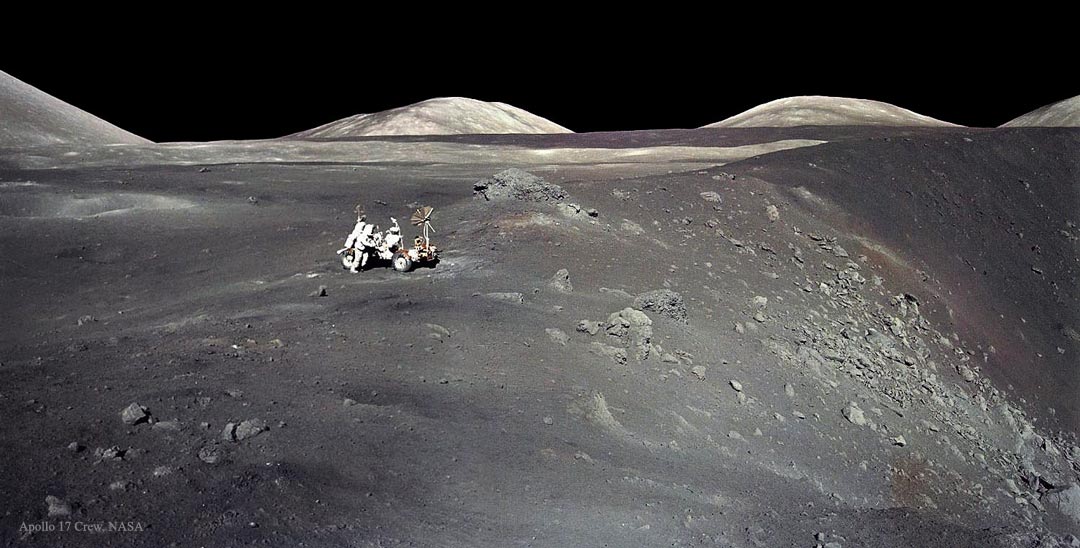
Apollo 17 at Shorty Crater


Fifty three years ago, in December of 1972, Apollo 17 astronauts Eugene Cernan and Harrison Schmitt spent about 75 hours on the Moon exploring the Taurus-Littrow valley, while colleague Ronald Evans orbited overhead. This snapshot from another world was taken by Cernan as he and Schmitt roamed the lunar valley's floor. The image shows Schmitt next to the lunar rover parked at the southeast rim of Shorty Crater. That location is near the spot where geologist Schmitt discovered orange lunar soil. The Apollo 17 crew returned with 110 kilograms of rock and soil samples, more than was returned from any of the other lunar landing sites. And for now, Cernan and Schmitt are the last to walk on the Moon.

from NASA https://ift.tt/dOi4y5Z

Comments

Popular posts from this blog

The Galactic Center in Radio from MeerKAT

What's happening at the center of our galaxy? It's hard to tell with optical telescopes since visible light is blocked by intervening interstellar dust. In other bands of light, though, such as radio , the galactic center can be imaged and shows itself to be quite an interesting and active place . The featured picture shows the latest image of our Milky Way's center by the MeerKAT array of 64 radio dishes in South Africa . Spanning four times the angular size of the Moon (2 degrees ), the image is impressively vast, deep, and detailed. Many known sources are shown in clear detail, including many with a prefix of Sgr, since the galactic center is in the direction of the constellation Sagittarius . In our Galaxy's Center lies Sgr A , found here in the image center, which houses the Milky Way's central supermassive black hole. Other sources in the image are not as well understood, including the Arc , just to the left of Sgr A , and numerous filamentary threads....

Peculiar Galaxies of Arp 273

The colorful, spiky stars are in the foreground of this image taken with a small telescope on planet Earth . They lie well within our own Milky Way Galaxy . But the two eye-catching galaxies in the frame lie far beyond the Milky Way, at a distance of over 300 million light-years. The galaxies' twisted and distorted appearance is due to mutual gravitational tides as the pair engage in close encounters. Cataloged as Arp 273 (also as UGC 1810 ), these galaxies do look peculiar , but interacting galaxies are now understood to be common in the universe. Closer to home, the large spiral Andromeda Galaxy is known to be some 2 million light-years away and inexorably approaching the Milky Way. In fact the far away peculiar galaxies of Arp 273 may offer an analog of the far future encounter of Andromeda and Milky Way. Repeated galaxy encounters on a cosmic timescale ultimately result in a merger into a single galaxy of stars. From our perspective , the bright cores of the Arp 273 galaxies...
Why is the sky near Antares and Rho Ophiuchi so colorful, yet dusty? The colors result from a mixture of objects and processes. Fine dust -- illuminated by starlight -- produces blue reflection nebulae . Gaseous clouds whose atoms are excited by ultraviolet starlight produce reddish emission nebulae . Backlit dust clouds block starlight and so appear dark . Antares , a red supergiant and one of the brighter stars in the night sky , lights up the yellow-red clouds on the upper right of the featured image. The Rho Ophiuchi star system lies at the center of the blue reflection nebula on the left, while a different reflection nebula, IC 4605 , lies just below and right of the image center. These star clouds are even more colorful than humans can see, emitting light across the electromagnetic spectrum . from NASA https://ift.tt/fdIYn7J