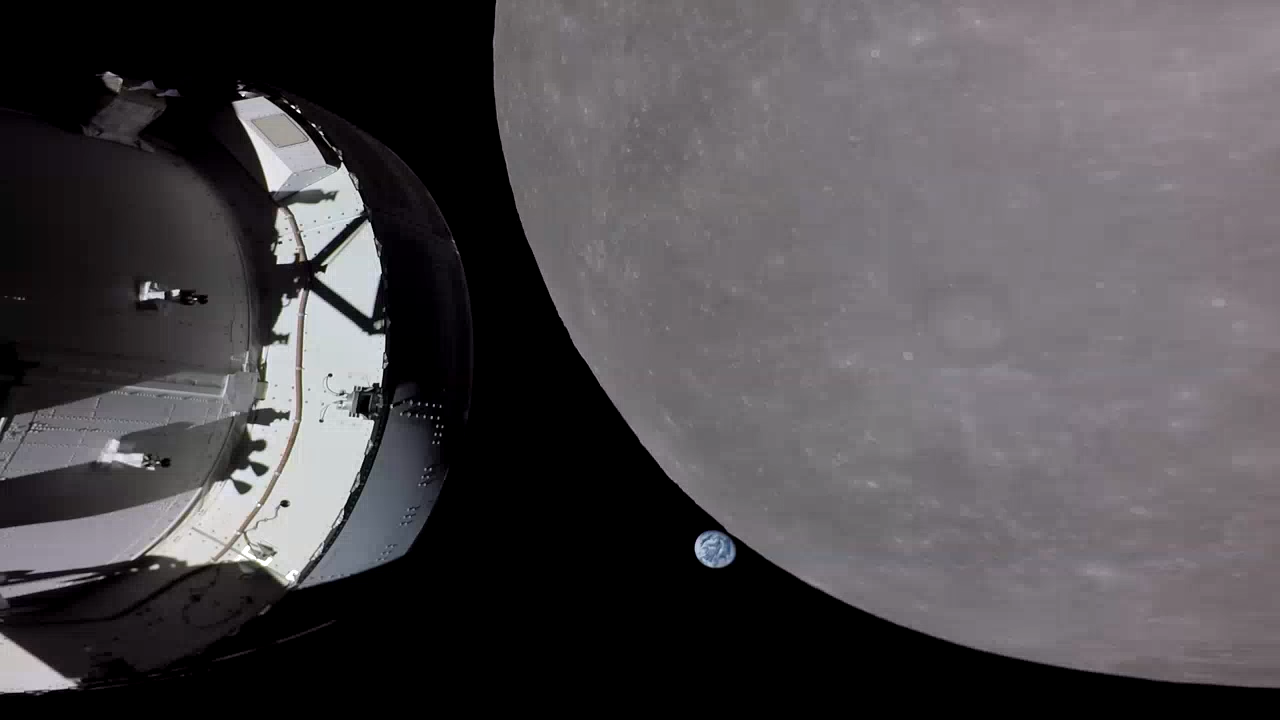
Earthset from Orion


Eight billion people are about to disappear in this snapshot from space taken on 2022 November 21. On the sixth day of the Artemis I mission, their home world is setting behind the Moon's bright edge as viewed by an external camera on the outbound Orion spacecraft. Orion was headed for a powered flyby that took it to within 130 kilometers of the lunar surface. Velocity gained in the flyby maneuver was used to reach a distant retrograde orbit around the Moon. That orbit is considered distant because it's another 92,000 kilometers beyond the Moon, and retrograde because the spacecraft orbited in the opposite direction of the Moon's orbit around planet Earth. Orion entered its distant retrograde orbit on November 25. Swinging around the Moon, Orion reached a maximum distance (just over 400,000 kilometers) from Earth on November 28, exceeding a record set by Apollo 13 for most distant spacecraft designed for human space exploration. The Artemis II mission, carrying 4 astronauts around the moon and back again, is scheduled to launch no earlier than September 2025.

from NASA https://ift.tt/OB2yh93

Comments

Popular posts from this blog

A Sagittarius Triplet

These three bright nebulae are often featured on telescopic tours of the constellation Sagittarius and the crowded starfields of the central Milky Way . In fact, 18th century cosmic tourist Charles Messier cataloged two of them; M8 , the large nebula below and right of center, and colorful M20 near the top of the frame. The third emission region includes NGC 6559 , left of M8 and separated from the larger nebula by a dark dust lane. All three are stellar nurseries about five thousand light-years or so distant. Over a hundred light-years across the expansive M8 is also known as the Lagoon Nebula. M20's popular moniker is the Trifid. Glowing hydrogen gas creates the dominant red color of the emission nebulae. But for striking contrast, blue hues in the Trifid are due to dust reflected starlight . The broad interstellarscape spans almost 4 degrees or 8 full moons on the sky. from NASA https://ift.tt/3eLgskj

The Gator Back Rocks of Mars

Wind-sharpened rocks known as ventifacts, cover this broad sloping plain in the foot hills of Mount Sharp, Gale crater, Mars. Dubbed gator-back rocks their rugged, scaly appearance is captured in these digitally stitched Mastcam frames from the Curiosity rover on mission sol 3,415 (March 15, 2022). Driving over gator-back rocks before has resulted in damage to the rover's wheels, so Curiosity team members decided to turn around and take another path to continue the rover's climb. Curiosity has been on an ascent of Gale crater's central 5.5 kilometer high mountain since 2014. As it climbs, it's been able to study layers shaped by water on Mars billions of years ago . from NASA https://ift.tt/IGon5ra

A Spiral Aurora over Iceland

What's happened to the sky? Aurora ! Captured in 2015, this aurora was noted by Iceland ers for its great brightness and quick development. The aurora resulted from a solar storm, with high energy particles bursting out from the Sun and through a crack in Earth's protective magnetosphere a few days later. Although a spiral pattern can be discerned, creative human s might imagine the complex glow as an atmospheric apparition of any number of common icons . In the foreground of the featured image is the Ölfusá River while the lights illuminate a bridge in Selfoss City . Just beyond the low clouds is a nearly full Moon. The liveliness of the Sun -- and likely the resulting auroras on Earth -- is slowly increasing as the Sun emerges from a Solar minimum , a historically quiet period in its 11-year cycle. from NASA https://ift.tt/2XgnyIE