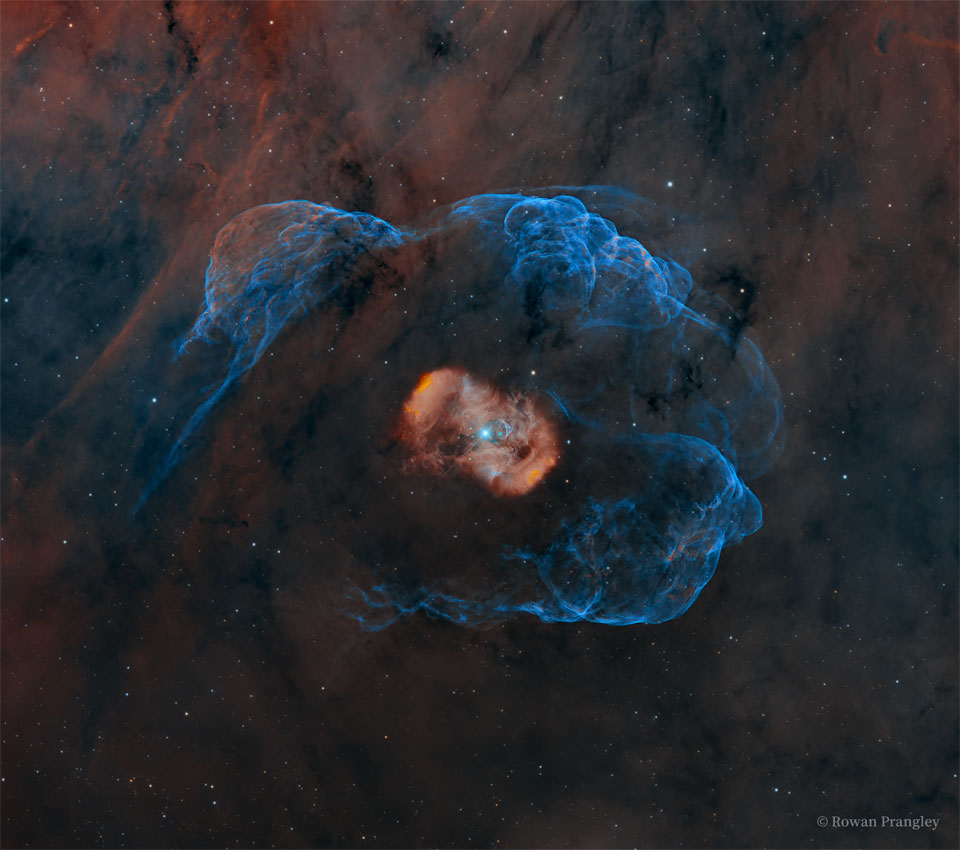
How did a star form this beautiful nebula? In the middle of emission nebula NGC 6164 is an unusually massive star. The central star has been compared to an oyster's pearl and an egg protected by the mythical sky dragons of Ara. The star, visible in the center of the featured image and catalogued as HD 148937, is so hot that the ultraviolet light it emits heats up gas that surrounds it. That gas was likely thrown off from the star previously, possibly the result of a gravitational interaction with a looping stellar companion. Expelled material might have been channeled by the magnetic field of the massive star, in all creating the symmetric shape of the bipolar nebula. NGC 6164 spans about four light years and is located about 3,600 light years away toward the southern constellation Norma.


from NASA https://ift.tt/vSGI1T5

Comments

Popular posts from this blog

The Observable Universe

How far can you see? Everything you can see, and everything you could possibly see, right now, assuming your eyes could detect all types of radiations around you -- is the observable universe . In light, the farthest we can see comes from the cosmic microwave background , a time 13.8 billion years ago when the universe was opaque like thick fog. Some neutrinos and gravitational waves that surround us come from even farther out, but humanity does not yet have the technology to detect them. The featured image illustrates the observable universe on an increasingly compact scale , with the Earth and Sun at the center surrounded by our Solar System , nearby stars , nearby galaxies , distant galaxies , filaments of early matter , and the cosmic microwave background . Cosmologists typically assume that our observable universe is just the nearby part of a greater entity known as "the universe" where the same physics applies. However, there are several lines of popular but spe...

Untitled

Why is our Sun so active now ? No one is sure. An increase in surface activity was expected because our Sun is approaching solar maximum in 2025. However, last month our Sun sprouted more sunspot s than in any month during the entire previous 11-year solar cycle -- and even dating back to 2002. The featured picture is a composite of images taken every day from January to June by NASA 's Solar Dynamic Observatory . Showing a high abundance of sunspots, large individual spots can be tracked across the Sun's disk, left to right, over about two weeks. As a solar cycle continues, sunspots typically appear closer to the equator. Sunspots are just one way that our Sun displays surface activity -- another is flares and coronal mass ejections (CMEs) that expel particles out into the Solar System . Since these particles can affect astronauts and electronics, tracking surface disturbances is of more than aesthetic value . Conversely, solar activity can have very high aesthetic v...

A Sagittarius Triplet

These three bright nebulae are often featured on telescopic tours of the constellation Sagittarius and the crowded starfields of the central Milky Way . In fact, 18th century cosmic tourist Charles Messier cataloged two of them; M8 , the large nebula below and right of center, and colorful M20 near the top of the frame. The third emission region includes NGC 6559 , left of M8 and separated from the larger nebula by a dark dust lane. All three are stellar nurseries about five thousand light-years or so distant. Over a hundred light-years across the expansive M8 is also known as the Lagoon Nebula. M20's popular moniker is the Trifid. Glowing hydrogen gas creates the dominant red color of the emission nebulae. But for striking contrast, blue hues in the Trifid are due to dust reflected starlight . The broad interstellarscape spans almost 4 degrees or 8 full moons on the sky. from NASA https://ift.tt/3eLgskj