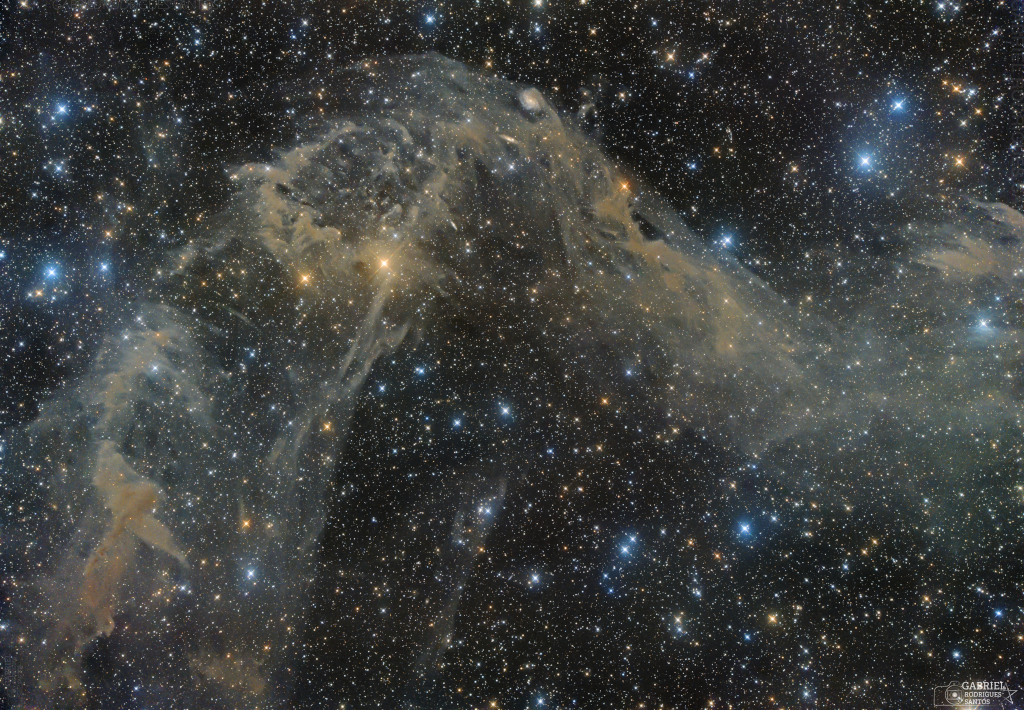
Galactic Cirrus: Mandel Wilson 9


The combined light of stars along the Milky Way are reflected by these cosmic dust clouds that soar 300 light-years or so above the plane of our galaxy. Known to some as integrated flux nebulae and commonly found at high galactic latitudes, the dusty galactic cirrus clouds are faint. But they can be traced over large regions of the sky toward the North and South Galactic poles. Along with the reflection of starlight, studies indicate the dust clouds produce a faint reddish luminescence as interstellar dust grains convert invisible ultraviolet radiation to visible red light. Also capturing nearby Milky Way stars and distant background galaxies, this remarkably deep, wide-field image explores a complex of faint galactic cirrus known as Mandel Wilson 9. It spans over three degrees across planet Earth's skies toward the far southern constellation Apus.

from NASA https://ift.tt/pG02Int

Comments

Popular posts from this blog

The Galactic Center in Radio from MeerKAT

What's happening at the center of our galaxy? It's hard to tell with optical telescopes since visible light is blocked by intervening interstellar dust. In other bands of light, though, such as radio , the galactic center can be imaged and shows itself to be quite an interesting and active place . The featured picture shows the latest image of our Milky Way's center by the MeerKAT array of 64 radio dishes in South Africa . Spanning four times the angular size of the Moon (2 degrees ), the image is impressively vast, deep, and detailed. Many known sources are shown in clear detail, including many with a prefix of Sgr, since the galactic center is in the direction of the constellation Sagittarius . In our Galaxy's Center lies Sgr A , found here in the image center, which houses the Milky Way's central supermassive black hole. Other sources in the image are not as well understood, including the Arc , just to the left of Sgr A , and numerous filamentary threads....

The Observable Universe

How far can you see? Everything you can see, and everything you could possibly see, right now, assuming your eyes could detect all types of radiations around you -- is the observable universe . In light, the farthest we can see comes from the cosmic microwave background , a time 13.8 billion years ago when the universe was opaque like thick fog. Some neutrinos and gravitational waves that surround us come from even farther out, but humanity does not yet have the technology to detect them. The featured image illustrates the observable universe on an increasingly compact scale , with the Earth and Sun at the center surrounded by our Solar System , nearby stars , nearby galaxies , distant galaxies , filaments of early matter , and the cosmic microwave background . Cosmologists typically assume that our observable universe is just the nearby part of a greater entity known as "the universe" where the same physics applies. However, there are several lines of popular but spe...

Peculiar Galaxies of Arp 273

The colorful, spiky stars are in the foreground of this image taken with a small telescope on planet Earth . They lie well within our own Milky Way Galaxy . But the two eye-catching galaxies in the frame lie far beyond the Milky Way, at a distance of over 300 million light-years. The galaxies' twisted and distorted appearance is due to mutual gravitational tides as the pair engage in close encounters. Cataloged as Arp 273 (also as UGC 1810 ), these galaxies do look peculiar , but interacting galaxies are now understood to be common in the universe. Closer to home, the large spiral Andromeda Galaxy is known to be some 2 million light-years away and inexorably approaching the Milky Way. In fact the far away peculiar galaxies of Arp 273 may offer an analog of the far future encounter of Andromeda and Milky Way. Repeated galaxy encounters on a cosmic timescale ultimately result in a merger into a single galaxy of stars. From our perspective , the bright cores of the Arp 273 galaxies...