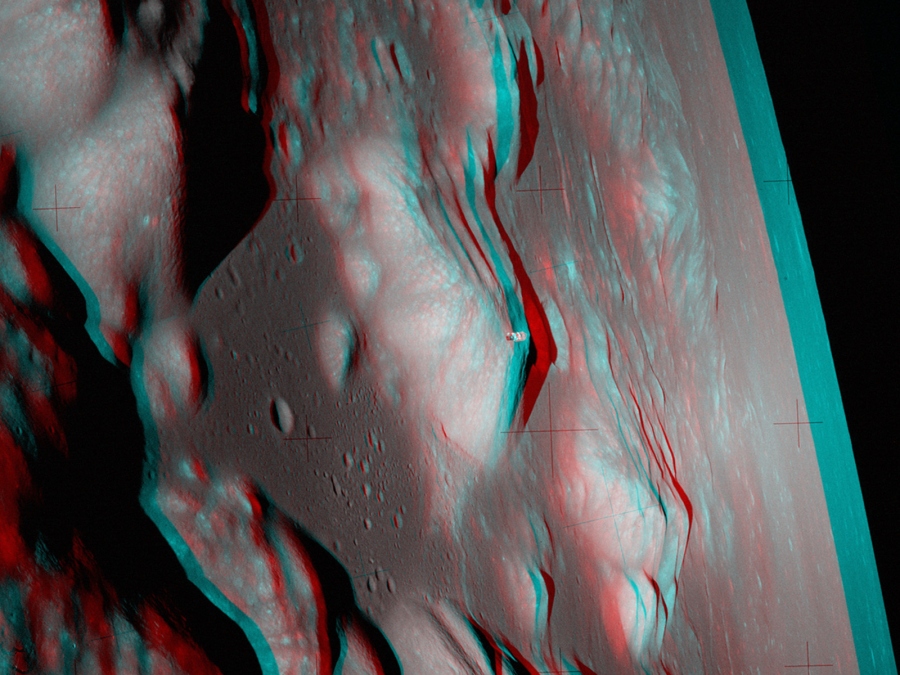
America and the Sea of Serenity


Get out your red/blue glasses and check out this stereo view of another world. Fifty years ago the scene was recorded by Apollo 17 mission commander Eugene Cernan on December 11, 1972, one orbit before descending to land on the Moon. The stereo anaglyph was assembled from two photographs (AS17-147-22465, AS17-147-22466) captured from his vantage point on board the Lunar Module Challenger as he and Dr. Harrison Schmitt flew over Apollo 17's landing site in the Taurus-Littrow Valley. The broad, sunlit face of the mountain dubbed South Massif rises near the center of the frame, above the dark floor of Taurus-Littrow to its left. Piloted by Ron Evans, the Command Module America is visible in orbit in the foreground against the South Massif's peak. Beyond the mountains, toward the lunar limb, lies the Moon's Mare Serenitatis.

from NASA https://ift.tt/lvUQS1F

Comments

Popular posts from this blog

A Spiral Aurora over Iceland

What's happened to the sky? Aurora ! Captured in 2015, this aurora was noted by Iceland ers for its great brightness and quick development. The aurora resulted from a solar storm, with high energy particles bursting out from the Sun and through a crack in Earth's protective magnetosphere a few days later. Although a spiral pattern can be discerned, creative human s might imagine the complex glow as an atmospheric apparition of any number of common icons . In the foreground of the featured image is the Ölfusá River while the lights illuminate a bridge in Selfoss City . Just beyond the low clouds is a nearly full Moon. The liveliness of the Sun -- and likely the resulting auroras on Earth -- is slowly increasing as the Sun emerges from a Solar minimum , a historically quiet period in its 11-year cycle. from NASA https://ift.tt/2XgnyIE

NGC 2419: Intergalactic Wanderer

Stars of the globular cluster NGC 2419 are packed into this Hubble Space Telescope field of view toward the mostly stealthy constellation Lynx . The two brighter spiky stars near the edge of the frame are within our own galaxy. NGC 2419 itself is remote though, some 300,000 light-years away. In comparison, the Milky Way's satellite galaxy, the Large Magellanic Cloud , is only about 160,000 light-years distant. Roughly similar to other large globular star clusters like Omega Centauri , NGC 2419 is intrinsically bright, but appears faint because it is so far away. Its extreme distance makes it difficult to study and compare its properties with other globular clusters that roam the halo of our Milky Way galaxy. Sometimes called "the Intergalactic Wanderer", NGC 2419 really does seem to have come from beyond the Milky Way. Measurements of the cluster's motion through space suggest it once belonged to the Sagittarius dwarf spheroidal galaxy , another small satellite...

The Gator Back Rocks of Mars

Wind-sharpened rocks known as ventifacts, cover this broad sloping plain in the foot hills of Mount Sharp, Gale crater, Mars. Dubbed gator-back rocks their rugged, scaly appearance is captured in these digitally stitched Mastcam frames from the Curiosity rover on mission sol 3,415 (March 15, 2022). Driving over gator-back rocks before has resulted in damage to the rover's wheels, so Curiosity team members decided to turn around and take another path to continue the rover's climb. Curiosity has been on an ascent of Gale crater's central 5.5 kilometer high mountain since 2014. As it climbs, it's been able to study layers shaped by water on Mars billions of years ago . from NASA https://ift.tt/IGon5ra