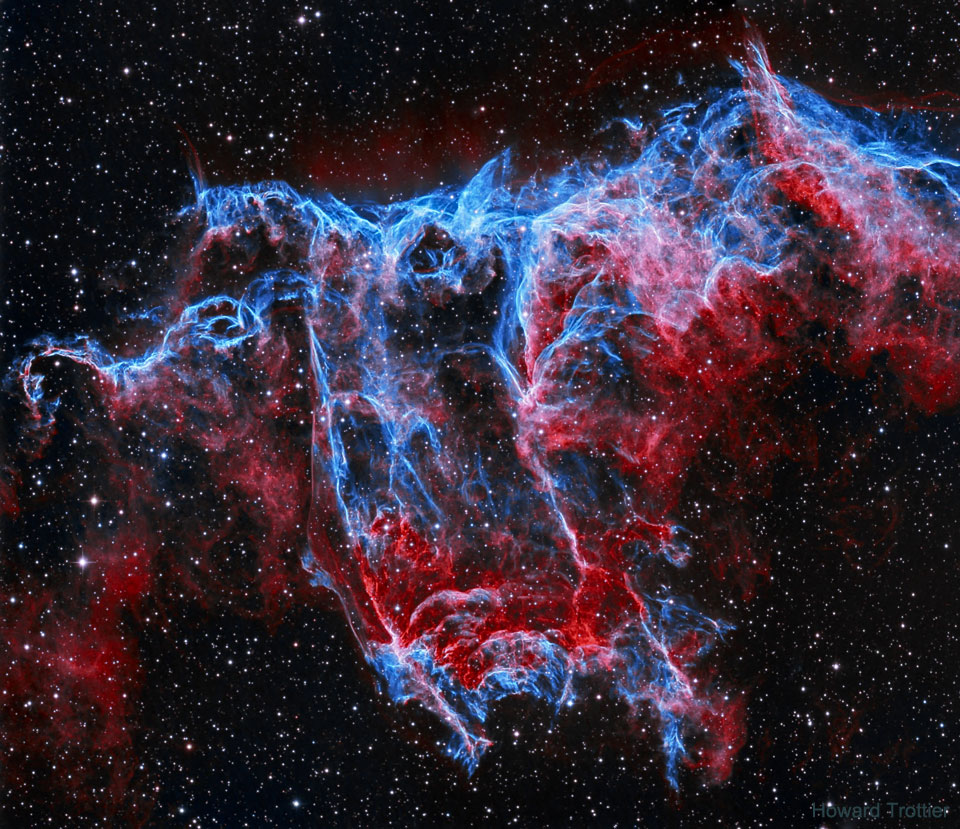
NGC 6995: The Bat Nebula


Do you see the bat? It haunts this cosmic close-up of the eastern Veil Nebula. The Veil Nebula itself is a large supernova remnant, the expanding debris cloud from the death explosion of a massive star. While the Veil is roughly circular in shape and covers nearly 3 degrees on the sky toward the constellation of the Swan (Cygnus), NGC 6995, known informally as the Bat Nebula, spans only 1/2 degree, about the apparent size of the Moon. That translates to 12 light-years at the Veil's estimated distance, a reassuring 1,400 light-years from planet Earth. In the composite of image data recorded through narrow band filters, emission from hydrogen atoms in the remnant is shown in red with strong emission from oxygen atoms shown in hues of blue. Of course, in the western part of the Veil lies another seasonal apparition: the Witch's Broom Nebula.

from NASA https://ift.tt/3nuu8o8

Comments

Popular posts from this blog

A Spiral Aurora over Iceland

What's happened to the sky? Aurora ! Captured in 2015, this aurora was noted by Iceland ers for its great brightness and quick development. The aurora resulted from a solar storm, with high energy particles bursting out from the Sun and through a crack in Earth's protective magnetosphere a few days later. Although a spiral pattern can be discerned, creative human s might imagine the complex glow as an atmospheric apparition of any number of common icons . In the foreground of the featured image is the Ölfusá River while the lights illuminate a bridge in Selfoss City . Just beyond the low clouds is a nearly full Moon. The liveliness of the Sun -- and likely the resulting auroras on Earth -- is slowly increasing as the Sun emerges from a Solar minimum , a historically quiet period in its 11-year cycle. from NASA https://ift.tt/2XgnyIE

NGC 2419: Intergalactic Wanderer

Stars of the globular cluster NGC 2419 are packed into this Hubble Space Telescope field of view toward the mostly stealthy constellation Lynx . The two brighter spiky stars near the edge of the frame are within our own galaxy. NGC 2419 itself is remote though, some 300,000 light-years away. In comparison, the Milky Way's satellite galaxy, the Large Magellanic Cloud , is only about 160,000 light-years distant. Roughly similar to other large globular star clusters like Omega Centauri , NGC 2419 is intrinsically bright, but appears faint because it is so far away. Its extreme distance makes it difficult to study and compare its properties with other globular clusters that roam the halo of our Milky Way galaxy. Sometimes called "the Intergalactic Wanderer", NGC 2419 really does seem to have come from beyond the Milky Way. Measurements of the cluster's motion through space suggest it once belonged to the Sagittarius dwarf spheroidal galaxy , another small satellite...

A High Cliff on Comet Churyumov Gerasimenko

This high cliff occurs not on a planet, not on a moon, but on a comet. It was discovered to be part of the dark nucleus of Comet Churyumov-Gerasimenko (CG) by Rosetta , a robotic spacecraft launched by ESA that rendezvoused with the Sun-orbiting comet in 2014. The ragged cliff, as featured here , was imaged by Rosetta in 2014. Although towering about one kilometer high, the low surface gravity of Comet CG would likely make it an accessible climb -- and even a jump from the cliff survivable. At the foot of the cliff is relatively smooth terrain dotted with boulders as large as 20 meters across. Data from Rosetta indicates that the ice in Comet CG has a significantly different deuterium fraction -- and hence likely a different origin -- than the water in Earth's oceans. Rosetta ended its mission with a controlled impact onto Comet CG in 2016. Comet CG has just completed another close approach to Earth and remains visible through a small telescope. from NASA https:/...