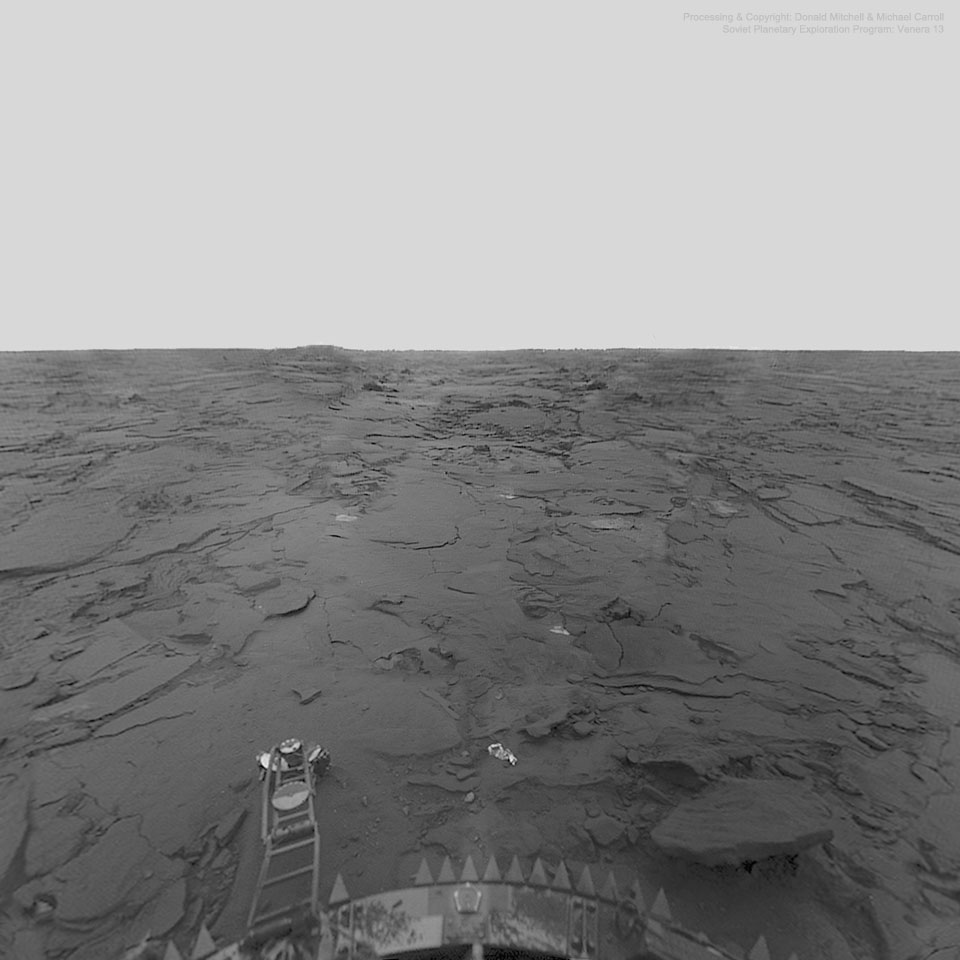
The Surface of Venus from Venera 13


If you could stand on Venus -- what would you see? Pictured is the view from Venera 13, a robotic Soviet lander which parachuted and air-braked down through the thick Venusian atmosphere in March of 1982. The desolate landscape it saw included flat rocks, vast empty terrain, and a featureless sky above Phoebe Regio near Venus' equator. On the lower left is the spacecraft's penetrometer used to make scientific measurements, while the light piece on the right is part of an ejected lens-cap. Enduring temperatures near 450 degrees Celsius and pressures 75 times that on Earth, the hardened Venera spacecraft lasted only about two hours. Although data from Venera 13 was beamed across the inner Solar System almost 40 years ago, digital processing and merging of Venera's unusual images continues even today. Recent analyses of infrared measurements taken by ESA's orbiting Venus Express spacecraft indicate that active volcanoes may currently exist on Venus.

from NASA https://ift.tt/2Oyoi7O

Comments

Popular posts from this blog

The Galactic Center in Radio from MeerKAT

What's happening at the center of our galaxy? It's hard to tell with optical telescopes since visible light is blocked by intervening interstellar dust. In other bands of light, though, such as radio , the galactic center can be imaged and shows itself to be quite an interesting and active place . The featured picture shows the latest image of our Milky Way's center by the MeerKAT array of 64 radio dishes in South Africa . Spanning four times the angular size of the Moon (2 degrees ), the image is impressively vast, deep, and detailed. Many known sources are shown in clear detail, including many with a prefix of Sgr, since the galactic center is in the direction of the constellation Sagittarius . In our Galaxy's Center lies Sgr A , found here in the image center, which houses the Milky Way's central supermassive black hole. Other sources in the image are not as well understood, including the Arc , just to the left of Sgr A , and numerous filamentary threads....

Untitled

Why is our Sun so active now ? No one is sure. An increase in surface activity was expected because our Sun is approaching solar maximum in 2025. However, last month our Sun sprouted more sunspot s than in any month during the entire previous 11-year solar cycle -- and even dating back to 2002. The featured picture is a composite of images taken every day from January to June by NASA 's Solar Dynamic Observatory . Showing a high abundance of sunspots, large individual spots can be tracked across the Sun's disk, left to right, over about two weeks. As a solar cycle continues, sunspots typically appear closer to the equator. Sunspots are just one way that our Sun displays surface activity -- another is flares and coronal mass ejections (CMEs) that expel particles out into the Solar System . Since these particles can affect astronauts and electronics, tracking surface disturbances is of more than aesthetic value . Conversely, solar activity can have very high aesthetic v...

The Doubly Warped World of Binary Black Holes

Light rays from accretion disks around a pair of orbiting supermassive black holes make their way through the warped space-time produced by extreme gravity in this stunning computer visualization. The simulated accretion disks have been given different false color schemes, red for the disk surrounding a 200-million-solar-mass black hole, and blue for the disk surrounding a 100-million-solar-mass black hole. That makes it easier to track the light sources, but the choice also reflects reality. Hotter gas gives off light closer to the blue end of the spectrum and material orbiting smaller black holes experiences stronger gravitational effects that produce higher temperatures. For these masses, both accretion disks would actually emit most of their light in the ultraviolet though. In the video, distorted secondary images of the blue black hole, which show the red black hole's view of its partner, can be found within the tangled skein of the red disk warped by the gravity of the bl...