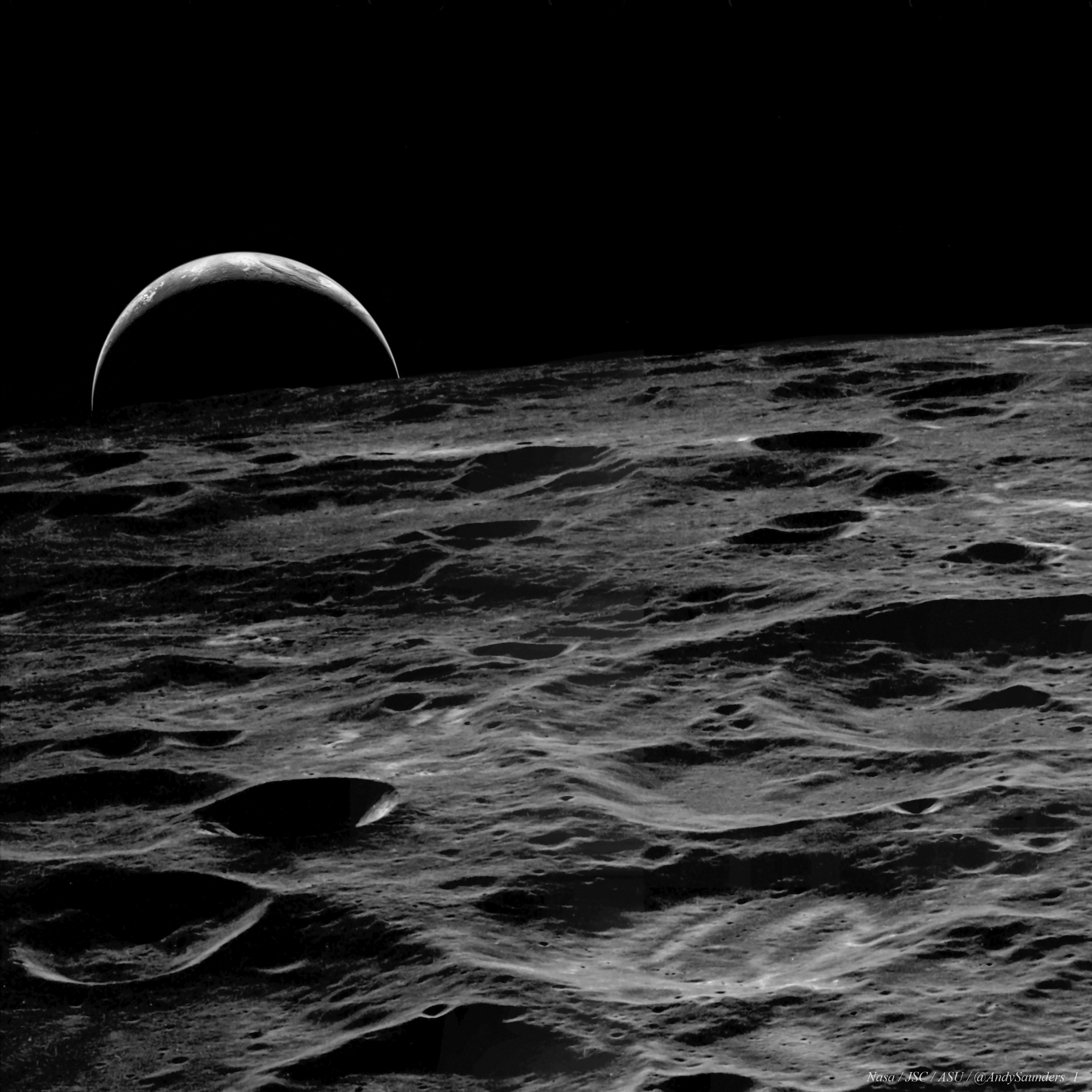
Apollo 14 Heads for Home


Fifty years ago this Sunday (February 7, 1971), the crew of Apollo 14 left lunar orbit and headed for home. They watched this Earthrise from their command module Kittyhawk. With Earth's sunlit crescent just peeking over the lunar horizon, the cratered terrain in the foreground is along the lunar farside. Of course, while orbiting the Moon, the crew could watch Earth rise and set, but from the lunar surface the Earth hung stationary in the sky over their landing site at Fra Mauro Base. Rock samples returned from Fra Mauro included a 20 pound rock nicknamed Big Bertha, determined to contain a likely fragment of a meteorite from planet Earth. Kept on board the Kittyhawk during the Apollo 14 mission was a cannister of 400-500 seeds that were later grown into Moon Trees.

from NASA https://ift.tt/3oTBMa2

Comments

Popular posts from this blog

The Observable Universe

How far can you see? Everything you can see, and everything you could possibly see, right now, assuming your eyes could detect all types of radiations around you -- is the observable universe . In light, the farthest we can see comes from the cosmic microwave background , a time 13.8 billion years ago when the universe was opaque like thick fog. Some neutrinos and gravitational waves that surround us come from even farther out, but humanity does not yet have the technology to detect them. The featured image illustrates the observable universe on an increasingly compact scale , with the Earth and Sun at the center surrounded by our Solar System , nearby stars , nearby galaxies , distant galaxies , filaments of early matter , and the cosmic microwave background . Cosmologists typically assume that our observable universe is just the nearby part of a greater entity known as "the universe" where the same physics applies. However, there are several lines of popular but spe...

NGC 1365: Majestic Island Universe

Barred spiral galaxy NGC 1365 is truly a majestic island universe some 200,000 light-years across. Located a mere 60 million light-years away toward the faint but heated constellation Fornax , NGC 1365 is a dominant member of the well-studied Fornax Cluster of galaxies. This sharp color image shows the intense, reddish star forming regions near the ends of the galaxy's central bar and along its spiral arms. Seen in fine detail, obscuring dust lanes cut across the galaxy's bright core. At the core lies a supermassive black hole. Astronomers think NGC 1365's prominent bar plays a crucial role in the galaxy's evolution, drawing gas and dust into a star-forming maelstrom and ultimately feeding material into the central black hole . from NASA https://ift.tt/A0ESVno

A Sagittarius Triplet

These three bright nebulae are often featured on telescopic tours of the constellation Sagittarius and the crowded starfields of the central Milky Way . In fact, 18th century cosmic tourist Charles Messier cataloged two of them; M8 , the large nebula below and right of center, and colorful M20 near the top of the frame. The third emission region includes NGC 6559 , left of M8 and separated from the larger nebula by a dark dust lane. All three are stellar nurseries about five thousand light-years or so distant. Over a hundred light-years across the expansive M8 is also known as the Lagoon Nebula. M20's popular moniker is the Trifid. Glowing hydrogen gas creates the dominant red color of the emission nebulae. But for striking contrast, blue hues in the Trifid are due to dust reflected starlight . The broad interstellarscape spans almost 4 degrees or 8 full moons on the sky. from NASA https://ift.tt/3eLgskj