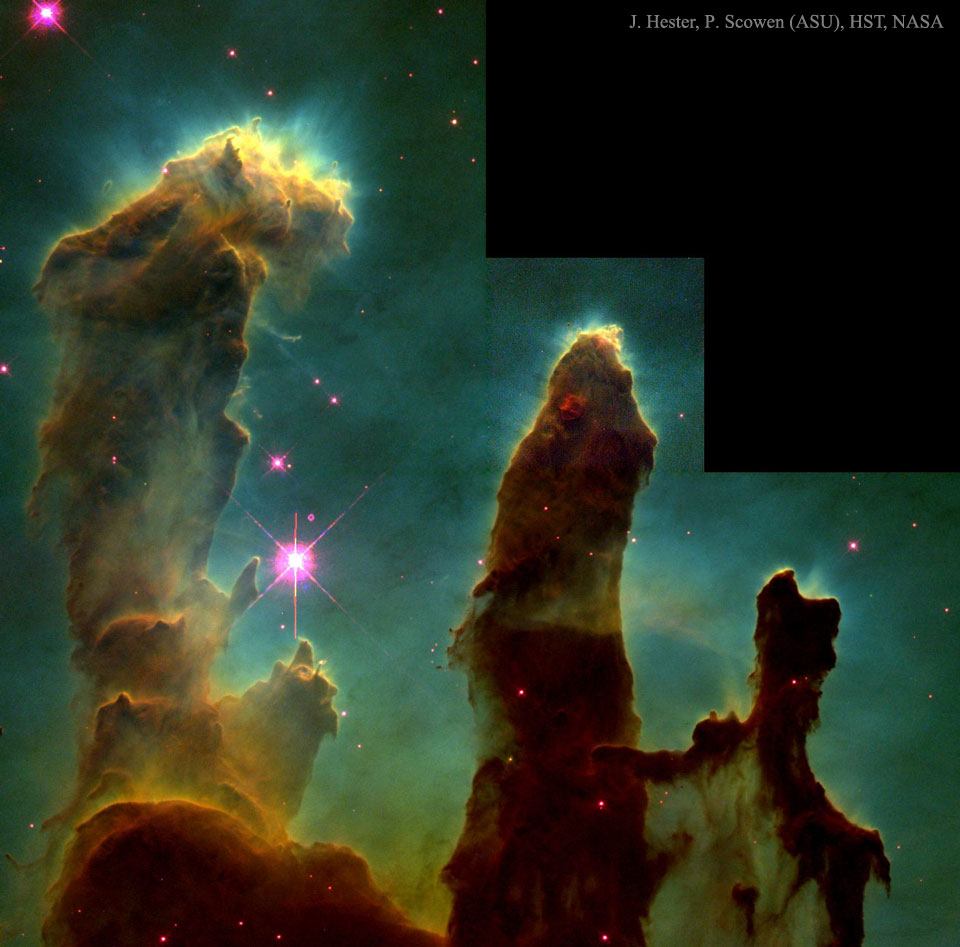
M16: Pillars of Star Creation


These dark pillars may look destructive, but they are creating stars. This pillar-capturing image of the inside of the Eagle Nebula, taken with the Hubble Space Telescope in 1995, shows evaporating gaseous globules (EGGs) emerging from pillars of molecular hydrogen gas and dust. The giant pillars are light years in length and are so dense that interior gas contracts gravitationally to form stars. At each pillars' end, the intense radiation of bright young stars causes low density material to boil away, leaving stellar nurseries of dense EGGs exposed. The Eagle Nebula, associated with the open star cluster M16, lies about 7000 light years away. The pillars of creation have been imaged more recently in infrared light by Hubble, NASA's Spitzer Space Telescope, and ESA's Herschel Space Observatory -- showing new detail.

from NASA https://ift.tt/3lMpQWb

Comments

Popular posts from this blog

Untitled

Why is our Sun so active now ? No one is sure. An increase in surface activity was expected because our Sun is approaching solar maximum in 2025. However, last month our Sun sprouted more sunspot s than in any month during the entire previous 11-year solar cycle -- and even dating back to 2002. The featured picture is a composite of images taken every day from January to June by NASA 's Solar Dynamic Observatory . Showing a high abundance of sunspots, large individual spots can be tracked across the Sun's disk, left to right, over about two weeks. As a solar cycle continues, sunspots typically appear closer to the equator. Sunspots are just one way that our Sun displays surface activity -- another is flares and coronal mass ejections (CMEs) that expel particles out into the Solar System . Since these particles can affect astronauts and electronics, tracking surface disturbances is of more than aesthetic value . Conversely, solar activity can have very high aesthetic v...

NGC 1365: Majestic Island Universe

Barred spiral galaxy NGC 1365 is truly a majestic island universe some 200,000 light-years across. Located a mere 60 million light-years away toward the faint but heated constellation Fornax , NGC 1365 is a dominant member of the well-studied Fornax Cluster of galaxies. This sharp color image shows the intense, reddish star forming regions near the ends of the galaxy's central bar and along its spiral arms. Seen in fine detail, obscuring dust lanes cut across the galaxy's bright core. At the core lies a supermassive black hole. Astronomers think NGC 1365's prominent bar plays a crucial role in the galaxy's evolution, drawing gas and dust into a star-forming maelstrom and ultimately feeding material into the central black hole . from NASA https://ift.tt/A0ESVno
What causes a blue band to cross the Moon during a lunar eclipse? The blue band is real but usually quite hard to see. The featured HDR image of last week's lunar eclipse, however -- taken from Norman , Oklahoma (USA) -- has been digitally processed to exaggerate the colors . The gray color on the upper right of the top lunar image is the Moon 's natural color, directly illuminated by sunlight. The lower parts of the Moon on all three images are not directly lit by the Sun since it is being eclipsed -- it is in the Earth's shadow . It is faintly lit, though, by sunlight that has passed deep through Earth's atmosphere . This part of the Moon is red -- and called a blood Moon -- for the same reason that Earth's sunsets are red: because air scatters away more blue light than red. The unusual purple-blue band visible on the upper right of the top and middle images is different -- its color is augmented by sunlight that has passed high through Earth's atmosphe...